Responsible Business Practice

Customer satisfaction and rights

Our services and service development follow a consumer-centric approach, and our subsidiaries have designed their customer communication processes according to their line of business. Our Group companies have both private and business customers, and as a media group, we also serve the wider public.

Group companies manage large customer databases, and as an increasingly complex digital media group, recognise risks related to data protection. Based on our 2024 DMA assessment, the only material topic, which can pose a potential negative impact and is also a risk, is related to customer data security and privacy, which can further materialize if no preventive measures and actions are in place.


The risk to Ekspress Grupp is related to:

personal data leakage
cyberattacks
similar hindering events, which in turn can lead to reputational damage.
AS Ekspress Grupp is a high public interest media company who is responsible for providing the wider audience with quality and transparent news, any occurrences of data leaks or safety-related violations mean direct reputational damage, which in turn can affect turnover and potentially lead to fines.

Impacts, Risks and Opportunities

Consumers want reliable services and the protection of their personal data in accordance with the requirements of the GDPR. The protection of customer data is an important part of our responsibility, which is directly related to consumers' right to privacy.

Topic Description Positive or Negative Value chain Expected time horizon
S4 Clients and end-users Customer data security and privacy Negative impact, risk Company Short to long term

Our targets and activities

While we have set targets related to clients’ and end-consumers' rights and interest, we are further developing our approach to measuring the impacts, including a thorough internal reporting process on matters related to media accessibility and security. In 2024 we have set the following targets for the upcoming year of 2025, which we will monitor annually:

• Zero breaches of clients’ and end-users’ personal data collection
• 100% of content covered by accessibility features

In order to further develop our strategical targets related to end-users' data privacy and accessibility to media content, we are planning both on a Group and company level implement the following activities:
Adopting personal data protection/ usability policy in line with GDPR
Adopt user safety policy/ principles regarding media content
Adopting policy/principles on targeted/ behavioural messaging and advertising to protect consumers' rights to access to (quality) information
Adopting a policy regarding critical content that must be made available for everyone

All aspects related to data protection are important and the Group makes sure that it complies with all related laws and regulations. We conduct data protection audits of our subsidiaries and thereby support the implementation of principles and procedures at the company level. Based on the Group level strategic activities, companies are expected to continuously implement the following activities:
Renewing and updating data protection systems regularly
Regular data protection trainings for all relevant employees
Providing users with simple and transparent ways to control how their data is being used
Identifying the need for and adopting specific accessibility features/tools/accessible formats: e.g. option to listen to the content, audio description, video subtitles, sign language etc. (WCAG)

Data protection

We guarantee the safety and privacy of our users and ensure maximum possible accessibility for different stakeholders beyond statutory obligations. We remediate the leak of GDPR-sensitive data by instantly discontinuing the activity causing the incident and restricting access to the exposed content. The problem is then analysed to identify the root cause and to delete the exposed data. The Group has a data protection officer whose task is to inform and advise the Group and its subsidiaries on data protection rights and obligations. The data protection officer actively participates in resolving issues related to the protection of personal data and ensures that the organization's employees have the necessary knowledge and skills to process personal data in an appropriate manner.

Accessibility of services

We ensure access to services in three ways:
• We facilitate the availability of services by creating innovative digital solutions.
• We ensure that critically important content is available to everyone, including non-subscribers.
• We increase the proportion of content covered by various accessibility measures on our media platforms in order to involve as large part of the society as possible in the information space.

Responsible and attractive employer

In our social aspects, we have set the goal of providing a professional environment for our employees that is inclusive and supportive, allowing to create the value for our end users through responsible media publications.
In Ekspress Grupp, we have over 950 employees whose dedication at work helps to fulfil the Group’s mission and goals. Quality tools, a flexible work organisation and a supporting team are an important part of creating a motivating work environment for quality media content.

Impacts, Risks and Opportunities

Retaining and developing current employees as well as training and supporting the next generation are important to us. We need professional and motivated employees both now and in the future. Recruiting the best in the labour market starts with the satisfaction of current employees. This, in turn, depends on the salary, but also on the open and inclusive organisational culture, development opportunities and the comfortable working environment we offer to employees. That is why we continuously contribute to creating a motivating work environment and invest in our employees’ wellbeing and competences.
Topic Description Positive or Negative Value chain Expected time horizon
S1 Own employees Working time Negative Company Short and medium term
S1 Own employees Measures against violence and harassment in the workplace Positive Company Short and medium term
S1 Own employees Workforce diversity & inclusion Risk Company Short to long term
S1 Own employees Employee privacy & data security Risk Company Short and medium term
S1 Own employees Secure employment, employee recruitment and retention Negative impact, risk Company Short to medium term
All the companies in our Group employ people with different mother tongue and cultural background. We are tolerant and treat all our employees equally and with integrity. Discrimination of employees on the basis of gender, race, mother tongue, political beliefs, age or any other aspect is prohibited.
We consider it important that our employees are satisfied and healthy, and we provide benefits and subsidies to our employees for health promotion and family events. If desired, we provide flexible working hours. Employees are often invited to attend summer days and other joint events together with their families, because family members play an important role in every employee's life.
All our employees, freelancers, and contractors may be exposed to different impacts due to our wide variety of operations, as shown in the table above. As majority of the identified IRO topics are potential negative impacts due to the nature of the industry or risks arising from the market competition, we thrive towards minimizing these potential negative impacts and risks to turn them into opportunities for Ekspress Grupp in the long run.
The main challenges include working time and job security of journalists coming from the sector specifics and risks in the form of high competition among media houses both on a national and regional level. We prioritise diversity, gender equality, equal pay, and inclusion among our employees, which allows us to better control our variety of activities in multiple sectors. We prioritise measures against violence and harassment to create a safe and supportive environment. Social dialogue, freedom of association, employees’ rights, and collective bargaining are essential for bringing diverse perspectives about our activities to light. We recognise training and skills development as vital, investing significantly in our employees’ growth and performance for their benefit and that of society and also for our activities.
Understanding the importance of health and safety, we are committed to continuously developing safe and suitable working environment and providing several health and other benefits to our employees. Although not a material topic for our subsidiaries or countries of operation, we are consciously dedicated to actively preventing forced and child labour within our value chain.

Our targets and activities

Although we have not set specific targets, we continuously evaluate our initiatives and their impacts at appropriate management levels as part of our business conduct. We have set KPIs to be measured for topics like personal and professional development, well-being, including safety, health and work-life balance and DEI, but we have not set any underlying targets or goals related to these metrics, which we will further develop during 2025, with the Group-wide implementation of our ESG governance practices. Despite that, our established processes are anchored within the functions that have day-to-day responsibility for ensuring adherence to our policies, in addition to our continuous engagement channels and channels to raise concerns. This decision reflects our commitment to strategic focus and industry-specific priorities.

Supply chain sustainability and lower environmental impact

Climate change

Although the environmental impact of the media sector is rather small, climate and environmental impact management is inevitable for a sustainable and responsible company. We have mapped our important areas of influence in the environmental field during the creation of the ESG strategy, also taking into account our supply chain, because we can largely control our environmental impact through our supply chain.

Impacts, Risks and Opportunities

The environmental impact of Ekspress Grupp is primarily related to printing - our companies publish newspapers, magazines and books. But in the case of the online format, it is also important to monitor which energy sources are used in the operation of the infrastructure necessary to maintain production and online platforms, and what is the environmental impact of the energy consumption of the devices of digital media consumers. In the case of a paper newspaper or magazine, a positive contribution is made if the reader shares it with family members or colleagues and later recycles it as wastepaper.
Topic Description Positive or Negative Value chain Expected time horizon
E1 Climate change Negative impact related to the resource use for products and services offered: (i) digital media - energy use of suppliers & end users, hardware production; (ii) printed media - paper production, distribution; (iii) screens - technology production, energy use, end of life electronic waste; (iv) events - energy use, logistics, waste Actual negative impact Company and value chain Short to long term

Our targets related to climate change mitigation

Media is among the industries with the lowest environmental impact, including climate impact. Our main environmental footprint is related to value chain impact of print media segment – paper sourcing and transport, printing, distribution, and end-of-life. However, we are aware that everything that concerns “digital” is the area with one of the fastest growing climate emissions – digital products and platforms, their energy consumption, networks and servers, also our network of screens. In Ekspress Grupp, we have set separate goals under our ESG strategy:


Delfi Meedia (digital and print) to reduce the total greenhouse gas emissions 80% by 2030, compared to base year of 2020

Rest of the Group (digital) to reduce the total greenhouse gas emissions by 2030 in line with Paris Agreement and Science Based Targets (from base year 2022), and reach net-zero emissions by 2050.
Climate impact
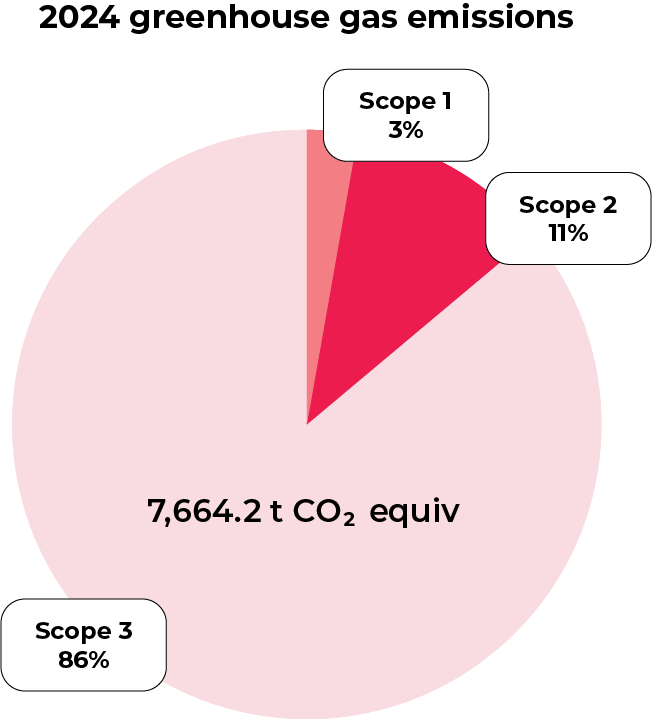
Since 2022, we have reported on our scopes 1, 2 and 3 emissions. In our efforts to improve data quality and the total scope of our emissions, we expanded our scope 3 reporting to include majority of the categories in 2024, including more detailed waste collection, products and services, business travels, use of end products, including the footprint of digital products and downstream transportation for paper media deliveries due to the sustainability push and improved data collection abilities of our collaboration partners.

Biodiversity and Ecosystems

Impacts, Risks and Opportunities

Based on our 2024 DMA process, we have identified one relevant material risk for Ekspress Grupp companies and value chain, which has a potential of realization in the medium and long term. Across all our core activities (digital media, ads, events and printed media) paper consumption in printed media has the largest impact on the businesses. Almost half of the emissions for Delfi Meedia and other printed media companies come from printed media and paper/ink consumption, which accounts for the largest portion of these emissions. With the significant use of paper in our main categories, there is a potential risk arising from regulatory aspects related to deforestation and use of trees for the production of paper – which can have several negative outcomes for Ekspress Grupp, especially related to our sustainability aspects, reputation, supply chain disruption and other aspects. While an important topic, due to the fact of it being high upstream in our value chain, we have not collected sufficient data from our value chain nor conducted consultations with affected communities.
Topic Description Positive or Negative Value chain Expected time horizon
E4 Biodiversity and ecosystems Deforestation Risk Company and value chain Medium and long term 

Our targets and activities

- As in our business model and recent years’ developments, we are less and less focusing on printed media and moving towards fully digital products and services. From one aspect it is within our business model and strategy to cater the needs and demands of our customers and with our end-users shifting towards more digital content with less printed media used, we are planning to phase out certain printed outlets during 2025, continuing with further phase-outs of printed media in 2026.
- As we currently do not have any targets set for deforestation and it’s effects on us, as mentioned we are continuously paying attention to the aspect by monitoring the changes in regulations related to the use of wood-based paper and using suppliers who adhere to environmental standards and use certified raw materials.
- We are planning to further enhance our ESG value chain monitoring systems and approaches in selecting suppliers and will increasingly address the underlying topic in our environmental policy.

Circular Economy

Impacts, Risks and Opportunities

Based on our DMA analysis done during 2024, we have identified one material actual positive impact and an actual negative impact that is related to our actions. As a positive impact, in all our companies, we emphasize the efficient use of resources including reuse of all paper products, some parts of digital out-door screens and the related equipment, sustainable procurement decisions, responsible waste management practices etc. As in our Group we produce physical publications of newspapers and magazines, it is within our responsibility to also emphasize circular economy principles to our readers and we therefore expect our end-users to act and behave according to similar principles we have set within the Group.
Topic Description Positive or Negative Value chain Expected time horizon
E5 Circular Economy Circular economy Positive impact Company Short and medium term
E5 Circular Economy Waste Negative impact Company Short to long term

Our targets and activities

- Even though all our locations and offices already follow waste management guidelines, these will be more formally documented and outlined in our policy. As mentioned above, 100% of our physical unsold copies of newspapers, magazines and books are diverted to recycling, however we will further in the environmental policy bring out the importance of end-user behaviour, including sharing of physical products and the correct actions to direct wastepaper into recycling.
- We have not identified any material targets relevant to disclose besides monitoring our proportion of printed materials unsold in retail that are directed to reuse, we are planning to further evaluate and set more detailed targets related circularity and waste during 2025.
- We have already largely stopped issuing invoices on paper, we have minimised the quantity of printed marketing materials, and our subsidiaries mostly use reusable materials, props and equipment when organizing events. Going forward, we will continue rolling out our centralised approach to waste management processes within our offices and educating the end-users on how to responsibly handle our printed media products by shared use and proper waste management.

Honest and responsible management

Correct and ethical business conduct is essential to our business model in Ekspress Grupp and the majority of which is dependent on our own workforce and workers in our value chain. As we operate in all three Baltic countries, compliance with relevant legislation and international guidelines on ethical business conduct is a priority because of the potential immediate legal and in turn economic, consequences of non-compliance, especially in the media sector.

Enhanced focus and monitoring on these topics allow minimizing ill-behaviour, which in turn impacts our ability to reach our goals regarding the maintenance of an efficient, competent business and workforce. A correct and ethical corporate culture which attempts to protect the stakeholders and employees against potential human rights impacts, intellectual property and media piracy and whistleblowers who report on these or any other issues, is not only strictly governed by legal procedures, but is also highly important for our strategy and commercial targets.
Honest and responsible management

We ensure the transparency and integrity of the management structure by implementing Ekspress Grupp's Code of Conduct in all Group companies. The Code of Conduct is a guide for every employee's daily business interactions inside and outside the company, and reflects our accepted standard of behaviour.

Supplier relationship management

In Ekspress Grupp, we are committed to practising fair behaviour in our management of suppliers and cooperation partners. Significant part of our environmental impact comes from our value chain. To manage this impact, we must consciously choose our suppliers and service providers as well as conduct active discussions with our partners to influence them to make more sustainable and responsible choices.

In 2023, we started integrating sustainability criteria into our purchasing principles, focusing primarily on environmentally friendly products and services. This served as an important first step and we have continued our efforts to expand these criteria during the last year. As our activities cover multiple different sectors throughout the value chain, in 2024, we have started to increasingly prioritize our suppliers’ commitment towards ESG matters.

Prevention of misconduct

In 2024, we continued to promote an open and transparent management culture. We maintain employee awareness through regular meetings, newsletters, and business ethics training that all new employees must complete. Going forward, we intend to reinforce these practices with more interactive training and enhanced supervision to firstly mitigate the probability of ill-behaviour incidents and secondly to solve them efficiently. Corruption and bribery cases are dealt with by a committee created on a case-by-case basis, the members of which are not related to the investigated case or the persons involved in it. We follow the principles of the UN Convention against Corruption.
Ekspress Grupp has a zero tolerance policy for any kind of corruption.
Corruption or the giving and accepting of bribes in both private and public sector is unacceptable. Therefore, our employees will not give, demand, receive or accept gifts, payments, services or other benefits from a current or potential business partner if the gift, payment, service or other benefit can reasonably be expected to influence the decision and goes beyond the limits of normal hospitality. We also do not tolerate illegal payments, bribes or favours aimed at speeding up decision-making in public authorities.
Incidents that are in conflict with the principles of business ethics or other values of Ekspress Grupp can be reported through the group-wide anonymous notification channel. To ensure confidentiality, the notification channel is managed by an external partner (WhistleB).
Notifications are sent over an encrypted connection and are password-protected. All reports of misconduct are treated in the strictest confidence. In 2024, six notifications were submitted there, but as none of them were relevant, they did not require further investigation.
EN
EE